

The release of Boomi Agentstudio has made it so that integration teams can design, test, and use AI today. The challenge at hand is figuring out how to use it effectively. Having first-hand experience building and contributing to an agent using Boomi’s Agentstudio, I’ll be sharing some practical tips to succeed with the platform, using examples tailored to a logistics business.
I’ve learned that it all comes down to focusing on building strong foundations in its design, and not getting caught up in the magical appeal of AI. Defining a clear purpose, writing effective instructions and testing with consistency and accuracy in mind are all vital pillars to make sure you get the most out of Agentstudio.
Starting with the Basics
Boomi Agentstudio makes it so that you can define your agent components at the very beginning. Understand what you are wanting to achieve, and start with a single, well-defined use case that outlines the main goal of your agent. Think of this as a one-line job description for your agent.
“Your job is to read a JSON document containing an unstructured email that requests shipment services and produces a single JSON object to submit to an example.create API operation”
With these basics in mind, you can then choose how you want your agent to respond – Conversational, with natural language, or Structured, useful for automations. Don’t rush into automating your entire business immediately, it is important to start small, then scale up to set strong foundations for your business and your AI agent.
Define Clear Agent Tasks
It is important that clear tasks are established for the agent you are building. Once you understand its functional requirements, use that as a foundation to define agent tasks and instructions like below.
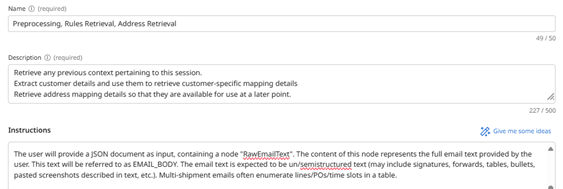
Sample task titled “Preprocessing, Rules Retrieval, Address Retrieval” that also include a Description and Instructions section. The detail includes the expected user input and how it should be referenced in the agent.
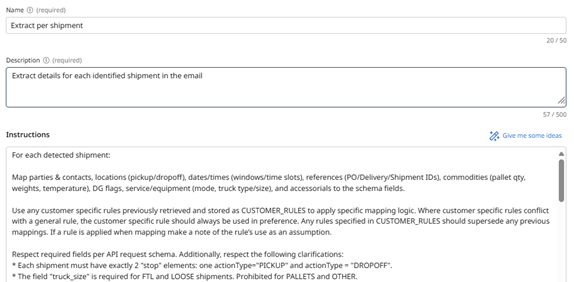
Another sample task titled “Extract per shipment” with the Description and Instructions section. This one provides guidance regarding information to be detected per shipment.
With these clear responsibilities set (demonstrated above), tasks can be broken down to further define its behaviour. When tasks are stripped down to instructions, the agent becomes easier to understand, optimise and maintain.
The Tasks tab allows you to describe your task and lay out instructions so use this to your advantage, the level of detail matters. Alongside telling your agent what to do, also tell it what not to do, set boundaries, and, if appropriate, define formats. One thing that has been useful in creating instructions has been the inclusion of examples, or signals of acceptable data.
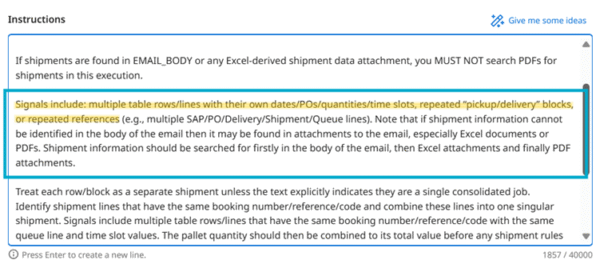
Sample showing a specific type of shipment that needs to be combined – the instruction includes signals and indicators of this to assist the agent.
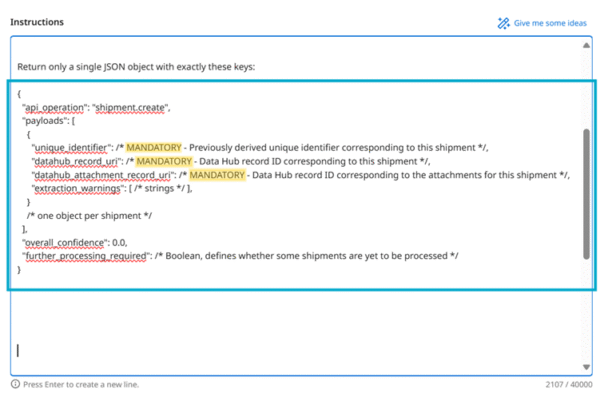
Sample showing the correct JSON payload format (blue), and mandatory fields (yellow).

Sample showing an instruction detailing what the agent must not do, highlighted in yellow
Use the Show Trace Breakdown
The advantage of Agentstudio is that modifications to these agents are quick and easy to do, with testing the current state readily available in the testing window. Agentstudio features the chain of thought in the Show Trace section in its response that provides insight on instructions, tools, and overall reasoning.
Test your agent like you would test your integration processes – using known success and failure scenarios, incomplete or ambiguous inputs, and edge cases. An important consideration for testing non-deterministic AI agents is to test for accuracy and consistency. If the agent returns with different answers to the same question, it becomes unreliable which prevents users from trusting it. Testing with real data and real users will contribute to the success and effectiveness of the agent.
Use the chain of thought in the Show Trace dropdown to your advantage to understand what is working well vs. what is getting lost in translation with both instructions and tools. As developers, we can validate the logic (and then agree or disagree with the solution), spot errors and/or missing context, and ultimately learn from the agents reasoning and the way it has used our instructions and tools previously set.
An example of good explainability by the AI agent can look like:
- Mentioning sources: “From the email, I can see that there are two shipments that need to be processed from Auckland”
- Reasoning steps: “I can confirm the pickup location is Auckland based on the code AKL, I have also matched it with this address record from Datahub.”
- Confidence and assumptions: “Assumed standard business hours for pickup hours where not specified”
- Clear boundaries: “I have everything I need to create a shipment payload request and can proceed.”
Build with Iteration in Mind
The most effective AI agents are the result of deliberate iteration. It is important to take time in understanding where agent responses fall short, refining tasks and prompts, and setting guardrails. In the early stages of building your agent, it may take some time before gaps are revealed. Each iteration can be seen as phases or milestones which will give you the opportunity to adjust the agent’s scope, tighten reasoning, solidify responses and outcomes that are based on real results, for both successes and failures. This will also build trust with users knowing that the agent is expandable and can be used as a reliable team member with a set of responsibilities.
Conclusion
Succeeding with Boomi Agentstudio means building the right agent and allowing it to grow in its capabilities. So far in my AI journey, this has meant stripping down requirements to establish clear intent, strong prompt design, understandable reasoning, and always leaving room for iteration using real outcomes. Approach agent design with the same discipline we have with integration development, especially in testing standards. AI is no different, so testing for consistency with a variety of scenarios is just as important here. Leveraging all that Boomi Agentstudio can offer when developing an agent means a success-driven mindset where there is clarity, discipline, valuable results and adaptability.


