AI Is changing the development triangle: why the real opportunity is quality

Iain Falconer

7 min read.

October 29, 2026

CONTENTS

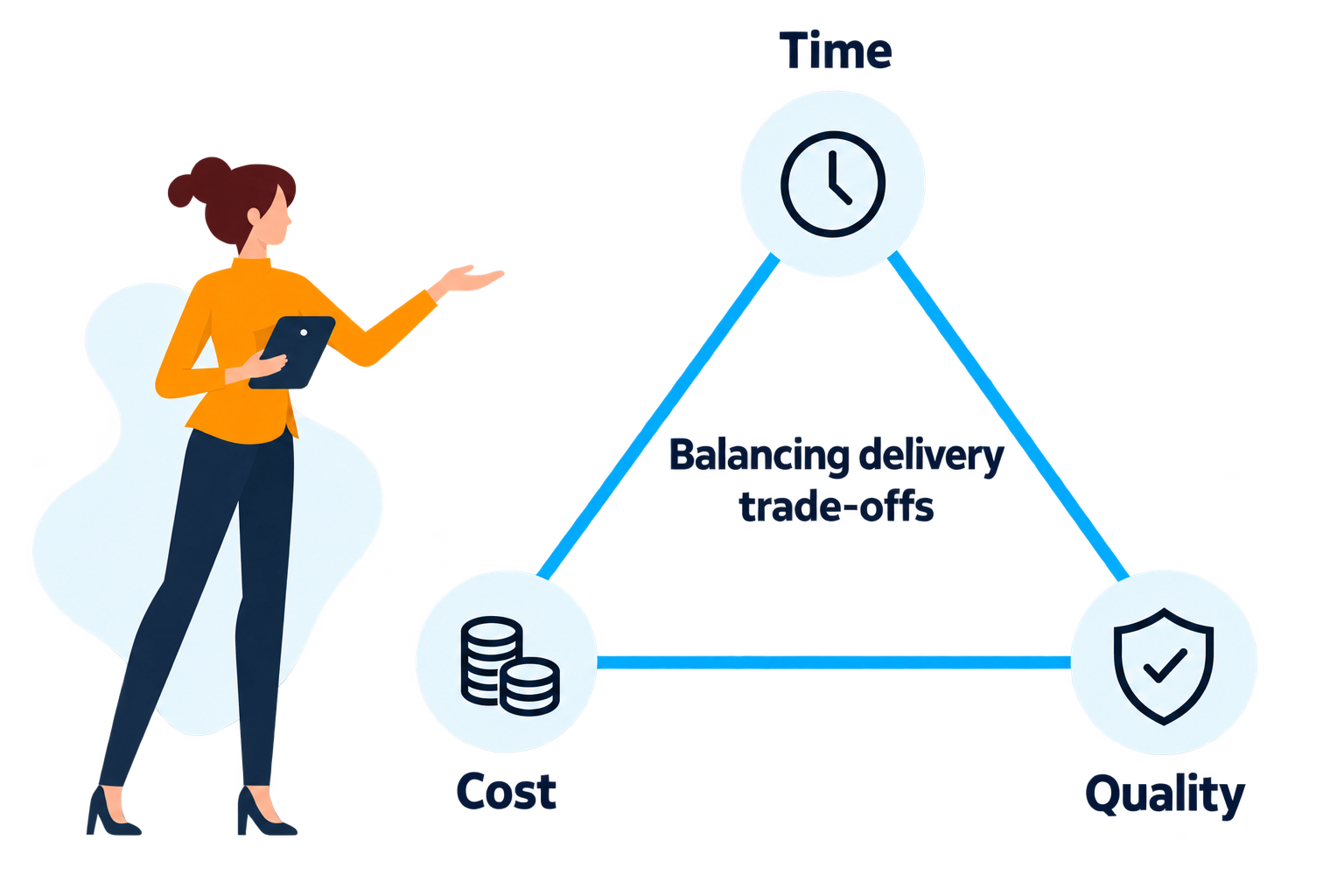
For decades, software delivery has been framed by a familiar trade-off between time, cost and quality. Teams have often been forced to prioritise one at the expense of another: accelerating delivery increases costs, reducing costs can compromise quality, and pursuing higher quality typically extends timelines.

The use of Artificial intelligence for Vibe Coding is beginning to disrupt this long-standing dynamic.

AI-assisted development tools are dramatically increasing developer productivity. Tasks that once required hours, such as boilerplate coding, API scaffolding, documentation drafts, test generation, can now be produced in minutes. This shift is already reducing the time and cost required to deliver software.

But the most strategic opportunity for organisations is not simply cheaper development.

The real opportunity lies in reinvesting those savings into quality.

The old development triangle (time, cost & quality)

In most delivery environments, teams constantly negotiate trade-offs:

  • Time: Release deadlines, market pressure, agile sprint commitments
  • Cost: Developer capacity, budget constraints, project funding
  • Quality: Code robustness, testing depth, documentation, maintainability

Historically, quality has been the dimension most often compromised. When delivery pressure increases, teams typically reduce:

  • Test coverage
  • Logging, monitoring and visualisation for post-production support
  • Documentation depth
  • Architectural refinement
  • Technical debt remediation

Over time, these trade-offs leave organisations with software that delivers value today but slows them down tomorrow.

AI has the potential to change that equation.

AI Is compressing time and cost

AI coding assistants can now generate:

  • Functional code snippets
  • API scaffolding
  • Infrastructure configuration
  • Design documentation
  • Automated tests
  • Test support, such as postman collections and test data

These tools reduce the effort required for many routine development tasks. Developers are increasingly shifting from writing code from scratch to reviewing, refining, and integrating AI-generated outputs.

For a practical example of AI-assisted development, see our guide on how to set up MuleSoft Vibes.

This has two immediate impacts:

  1. Delivery speed increases
  2. Development effort decreases

However, treating AI purely as a cost reduction mechanism risks missing its larger strategic value.

If the only outcome is fewer developer hours, organisations risk producing more code faster, but not necessarily better software.

Why quality becomes the differentiator

Instead of simply reducing project budgets, forward-looking organisations can repurpose the time and cost savings generated by AI into improving software quality.

Quality in modern software delivery is multi-dimensional. It includes:

  • Documentation quality
  • Testing coverage
  • Code quality
  • Consistency across teams
  • Architectural integrity
  • Future-proof design

This reinvestment shifts the focus to helping ensure code remains maintainable, secure, and scalable as business needs evolve.

Documentation: from afterthought to asset

Documentation is often one of the first things sacrificed when teams are under pressure to deliver. However, it plays a critical role in helping new developers get up to speed, supporting operational teams, enabling reuse, and preserving knowledge as people and projects change over time.

While AI can now generate documentation alongside code, its output still needs review to ensure it is accurate, relevant, and reflects the realities of the implementation.

By investing some of the time saved through AI into reviewing and maintaining documentation, organisations can build a valuable knowledge base that continues to support teams long after the initial delivery is complete.

Automated testing as a validation layer for AI

As AI takes on a greater role in code generation, the focus for developers increasingly shifts from writing code to reviewing, validating, and refining it. This makes automated testing more important than ever.

Effective test coverage does more than identify defects. It helps verify that AI-generated code behaves as intended, protects against regressions, documents expected system behaviour, and provides the confidence needed to make changes safely.

As a result, organisations adopting AI-assisted development are often strengthening their investment in testing practices, including unit, integration, contract, and automated regression testing. These capabilities provide the safeguards needed to maintain quality and reliability as development accelerates.

In this model, tests become the guardrails that ensure AI-generated code remains trustworthy.

Quality assurance beyond testing

Quality extends beyond ensuring that software functions correctly. As AI-generated code becomes more common, organisations must also manage the risks that can emerge when code is produced at scale, including inconsistent implementation patterns, architectural drift, duplicated logic, security concerns, and misalignment with enterprise standards.

Addressing these challenges demands strong engineering practices, effective governance, and clear architectural oversight to ensure that software remains maintainable, secure, and aligned with broader business and technology objectives.

Reinvested capacity can strengthen practices such as:

Code quality and consistency

Teams can implement automated checks for:

  • Coding standards
  •  Linting and formatting
  • Dependency management
  • Vulnerability scanning

This ensures that AI-generated code integrates seamlessly with existing systems.

Architectural alignment

AI tools generate code based on prompts[RS6.1], but they do not inherently understand an organisation’s architecture, design principles, or strategic technology direction. Training the AI agents through well-defined skills, as demonstrated through Claude and MuleSoft Vibes, help align the code outcomes, helping ensure consistency and best practice.

Maintaining architectural integrity still requires deliberate oversight to ensure solutions align with established API strategies, domain boundaries, integration patterns, security requirements, and broader enterprise standards.

Without this discipline, rapid AI-assisted development can lead to fragmented architectures.

Future-proof design

One of the true measures of software quality is how well a system handles change. While AI-generated code may address an immediate need, long-term success depends on building solutions that can scale, be monitored effectively, accommodate new capabilities, and remain resilient as complexity grows.

These considerations require deliberate design decisions that extend beyond the code itself. By reinvesting some of the efficiencies gained through AI into these areas, organisations can create software that not only delivers value today but continues to support changing business needs over time.

Investing saved effort into design reviews and architectural thinking ensures solutions remain adaptable as business needs change, requiring consideration of both current and future needs, while also avoiding over-engineering. An AI agent will not necessarily include these considerations in to design and code, unless specifically prompted to do so.


A new balance in the development triangle

AI does not eliminate the time, cost, or quality triangle, but it reshapes it.

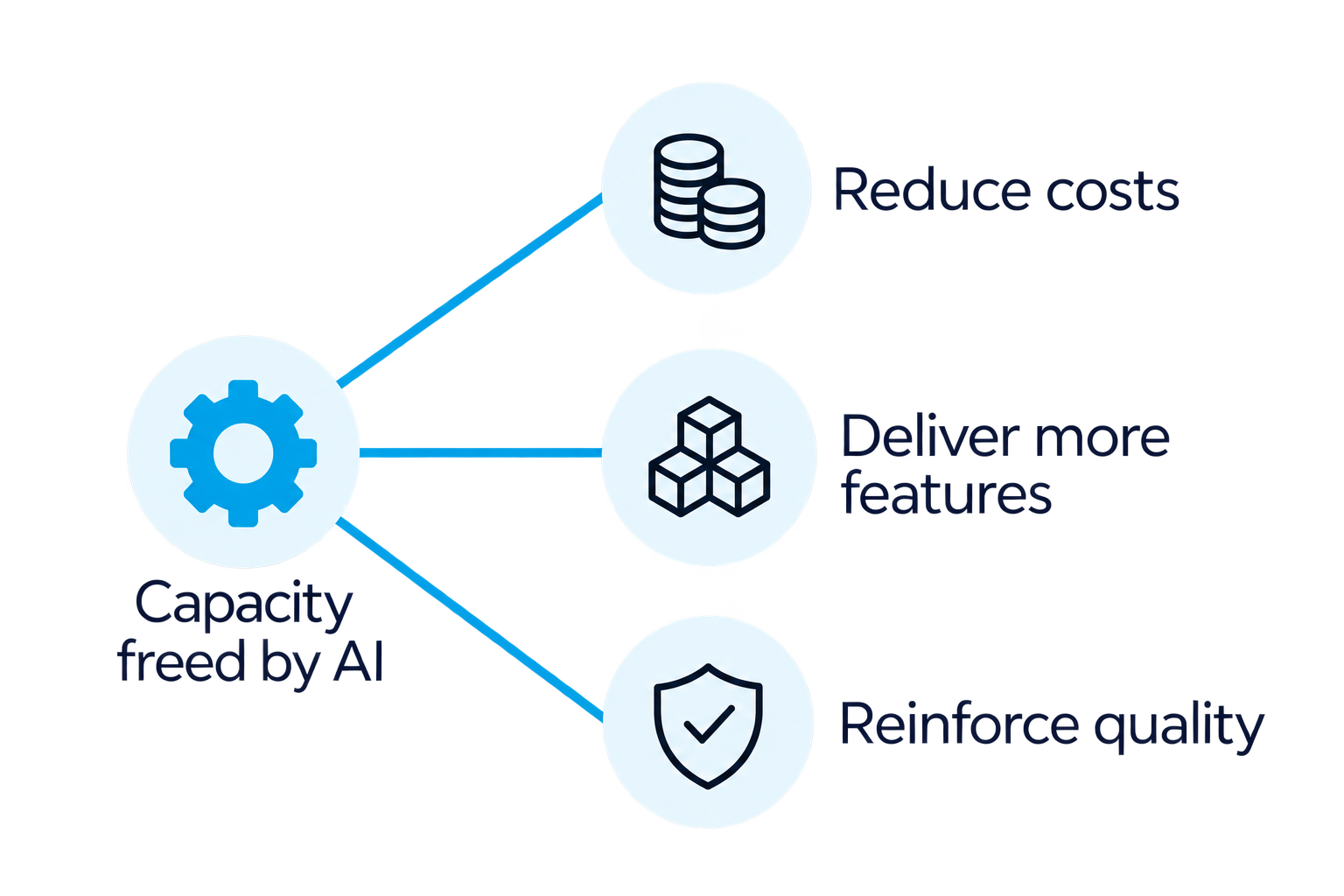
By reducing the effort required for many development tasks, AI creates new capacity within delivery teams.

Organisations now have a choice:

1. Reduce costs and deliver the same quality (assuming AI quality is equal to developer)
2. Deliver more features at the same speed
3. Reinvest in higher quality software

The third option is where the long-term value lies.

What mature engineering organisations do differently?

The most mature AI-enabled engineering organisations will not measure success purely by lines of code generated or development hours saved.

Instead, they will measure improvements in:

  • System reliability
  • Maintainability
  • Developer onboarding speed
  • Test coverage
  • Architectural consistency
  • Long-term technical debt

AI makes it possible to deliver faster but the organisations that benefit most will be those that use AI to deliver better.

The strategic shift

Vibe Coding with AI is a productivity tool for developers, however it cannot be used with blind faith that the Agent will understand the requirements and produce the correct or optimal code, so it does still require expertise to review, validate and test the output.

However, it will also dramatically change how organisations allocate and use engineering expertise, together with a broader team, to deliver business outcomes.

When development becomes faster and cheaper, the opportunity emerges to finally invest properly in areas that were historically underfunded:

  • Automated testing
  • Scenarios based process validation
  • Code quality assurance
  • Architectural governance

Let’s not move forward producing more code faster, into production and end up with more brittle applications, with fear of change, and impact to business processes. We now have the time and budget to invest in robust change management processes to help continue to improve and extend functionality without fear of breaking the business.

AI provides us the tools to finally have confidence to deliver software applications at pace, with quality.

Take the next step

Adaptiv can help you move from exploring AI-assisted development to putting it into practice. We’ll work with your team to establish the right processes, guardrails and skills, then test real use cases within your MuleSoft environment.

Talk to our team about getting started.

Ready to put AI-assisted development into practice?

top